Many of us know what it’s like to have a real encounter with God and then struggle to keep walking once the emotion fades.
A worship night stirs hunger. A sermon brings conviction. Prayer awakens hope. And then daily life returns. The dishes still need to be washed. Work still has demands. Children still need attention. Pain may still be there, and questions remain.
That’s exactly where the altar life is formed. Not only in the dramatic moments, but in the repeated return.
A fire that must not go out
In the Old Testament, the priests were given a clear command:
“The fire on the altar shall be kept burning on it; it shall not go out.”
Leviticus 6:12
That instruction belonged to Israel’s sacrificial system, and we need to read it in context. We aren’t under the Levitical priesthood in the same way, because Christ offered Himself once for all. We don’t keep a physical fire burning to make sacrifices for sin.
But the picture still teaches us something beautiful. Fire isn’t tended by accident. What’s holy shouldn’t be neglected.
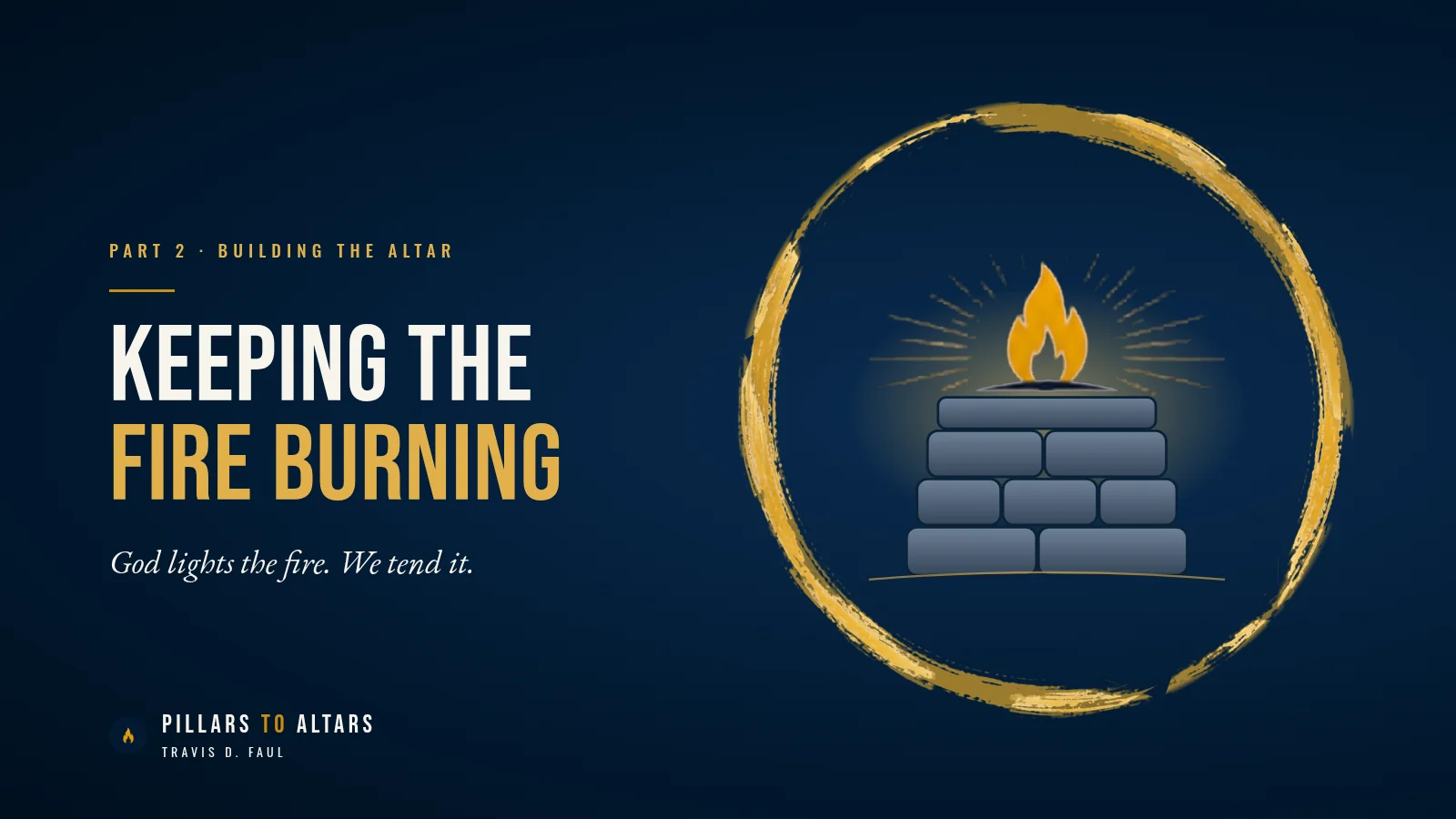
God lights it. We tend it.
Here’s where it’s easy to get this wrong. Talk about spiritual rhythms can start to sound like human effort to produce God’s presence. That isn’t the gospel. We don’t create God’s nearness by the intensity of our worship or the number of chapters we read. He loved first. He spoke first. He came near first.
On Mount Carmel, Elijah prepared the altar, arranged the sacrifice, and prayed. But he didn’t produce the fire. God answered by fire, and the people cried out, “The LORD, he is God” (1 Kings 18:39).
We can’t manufacture encounters, but we can prepare the altar and make room. Paul told Timothy to “fan into flame the gift of God” (2 Timothy 1:6). The gift came from God, but Timothy was called to tend it.
Some of us drift toward striving: “If I do enough, God will finally come near.” Others drift toward passivity: “If God wants me to grow, He’ll do it while I stay the same.” Neither is the life Scripture describes. I call it holy cooperation. God ignites, and we tend.
Altar life is holy cooperation. It is not striving to make God come near, it is faithfully tending what His grace has begun.
Worship reorders our love
Worship is bigger than music, though music is a beautiful gift. It’s the whole-life response of love, reverence, gratitude, and surrender to God. In a world that trains our attention toward fear, comparison, and outrage, worship turns us back toward what’s real: God is holy, good, faithful, and near.
Worship doesn’t ignore pain, either. Psalm 13 begins with “How long, O LORD?” and still ends here:
“But I have trusted in your steadfast love; my heart shall rejoice in your salvation.”
Psalm 13:5
That movement is worship. What we behold, we begin to love, and what we love, we begin to follow.
The Word anchors the fire
If worship reorders love, the Word anchors truth. Without Scripture, we can start confusing what feels strong with what is true. Not every strong feeling is the voice of God, and the Word teaches us how to tell the difference.
“Your word is a lamp to my feet and a light to my path.”
Psalm 119:105
A lamp usually doesn’t show the whole road. It gives enough light for the next step. Fire without truth can become a wildfire, and truth without fire can become cold. When worship and the Word belong together, the heart is warmed and guided.
Prayer keeps us close
Prayer sustains communion. Many of us struggle with prayer because we think it has to sound impressive. But the Father isn’t moved by performance. He wants relationship with His children. Prayer can be ten minutes of passionate conversation, or three seconds of acknowledging Him and asking Him to be near.
It can start with, “Father, I don’t know what to say.” And when we don’t, Scripture tells us the Spirit helps us in our weakness (Romans 8:26).
When the fire feels low
Every believer goes through seasons when worship feels dry, Scripture feels hard, and prayer feels like talking into silence. Dryness isn’t always failure. Sometimes it teaches us to love God for Himself rather than for the feelings we associate with Him. Even when we only have the strength to whisper, “Father, help me,” God receives the offering.
Start small enough to obey
You don’t need an impressive routine. A rule of life is just a pattern of practices that helps you live with God on purpose. It’s a trellis that helps the vine grow, not a law to judge yourself by. For some, it starts with ten quiet minutes in the morning: a psalm, a short prayer, and a surrendered yes.
A rhythm you can keep is better than an ideal you keep abandoning. And remember that you don’t tend the fire alone. In Christ we’re a royal priesthood, and we tend it together.
The altar life isn’t about keeping up an image of constant spiritual intensity. It’s about becoming a person whose life keeps returning to God, when the flame feels bright and when it seems hidden under the ashes.
A pillar remembers the encounter. An altar tends the fire.
Go deeper in Pillars to Altars, Chapter 8: Worship, Word, Prayer, and the Fire on the Altar.