If we’re going to build our lives on the Word of God, it’s fair to ask whether that Word can bear the weight.
Many people today think of the Bible as a religious version of the telephone game: stories passed from person to person until the original message is distorted beyond recognition. Even believers who love Jesus can carry a quiet question underneath: Can I really trust this, not only as inspiration, but as a foundation?
Those aren’t always hostile questions. Often they’re honest ones. And we don’t need to be afraid of them.
Faith isn’t the opposite of evidence
Sometimes people talk as if faith means believing without any reason, as though belief becomes more spiritual the less support it has. Scripture doesn’t describe faith that way.
“Now faith is the assurance of things hoped for, the conviction of things not seen.”
Hebrews 11:1
Faith reaches beyond what we can see, but it isn’t blind. Love, beauty, justice, and the presence of God aren’t less real just because they can’t be put in a test tube. The unseen is not the unreal.
Biblical faith is trust, and trust grows from knowing who God is and remembering what He has done. God has not left Himself without witness. He has spoken, acted in history, made promises, and kept them.
One story from many voices
One of the most remarkable pieces of evidence for the Bible isn’t buried in the ground. It’s the Bible’s own unity.
Scripture wasn’t written by one person in one room. It was written across roughly fifteen hundred years by around forty human authors, on three continents, in three primary languages: Hebrew, Aramaic, and Greek. Its writers included shepherds, kings, prophets, priests, fishermen, tax collectors, poets, and exiles. They wrote from deserts, palaces, and prisons.
On paper, that should have produced a scattered religious library. Instead, Scripture tells one cohesive story. It begins with God dwelling with humanity in Eden, and it ends with God dwelling with His people forever in the new creation. In between, we see God’s faithfulness, humanity’s rebellion, the promise of redemption, and that promise fulfilled in Jesus Christ.
That unity doesn’t erase the human authors. Moses, David, Isaiah, Luke, Paul, and John each write with their own voice. But beneath the variety, one thread holds it together.
“All Scripture is breathed out by God and profitable for teaching, for reproof, for correction, and for training in righteousness.”
2 Timothy 3:16
“Breathed out by God” doesn’t mean the writers were erased. It means God was at work through them, carrying one revelation forward.
A web of connections
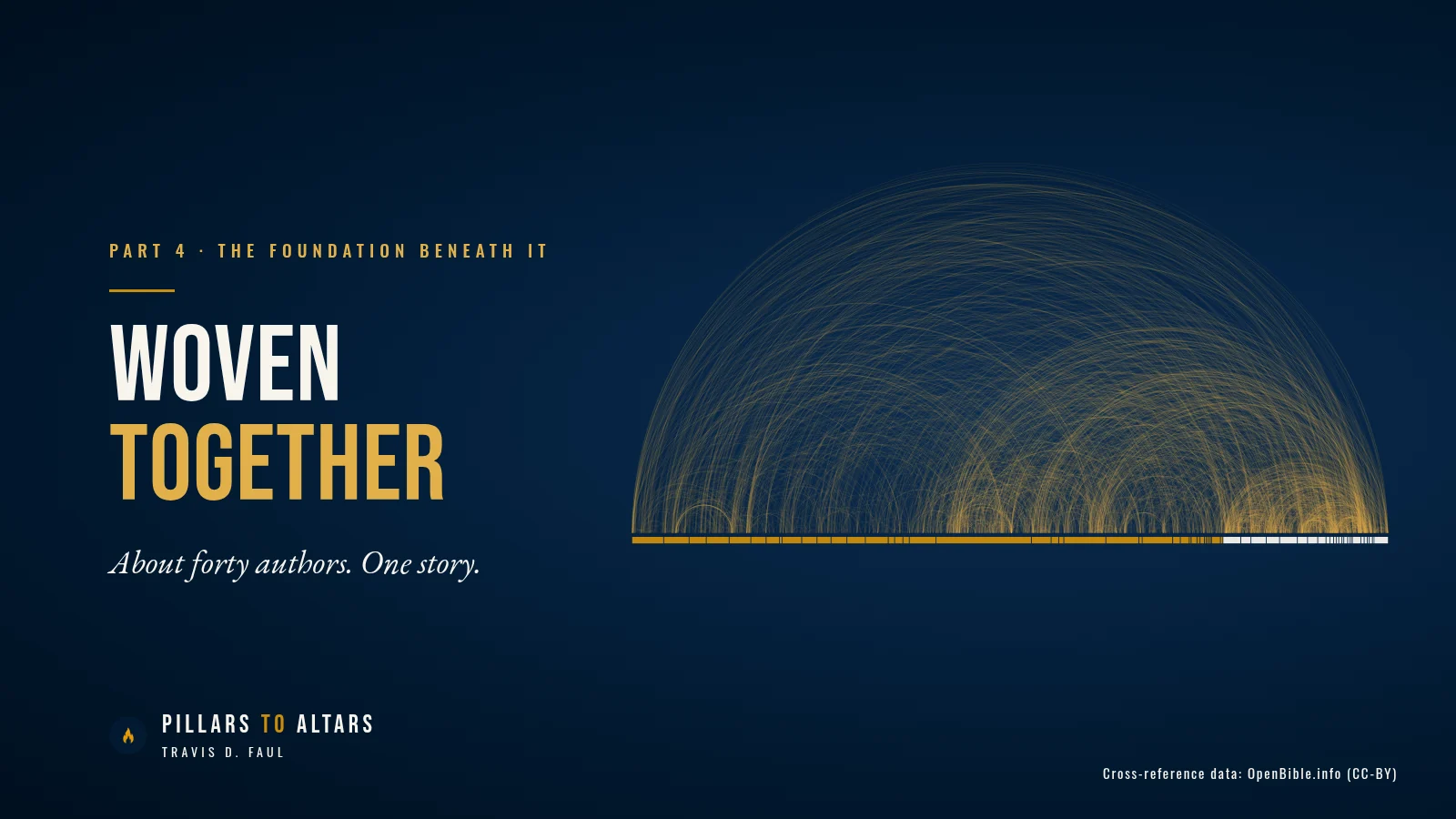
This is why cross-references matter so much. Some studies and visual representations of the Bible have identified tens of thousands of connections within the text, often citing a number around 63,779. The exact count depends on the method, but the point stands: the Bible is woven together with an astonishing network of internal connections.
Later writers quote earlier writers. The prophets echo the Torah. The Psalms remember the Exodus. The Gospels show Jesus fulfilling the Law, the Prophets, and the Writings. Revelation gathers images from Genesis, Exodus, Daniel, Ezekiel, Isaiah, and many other places into a final vision of worship and new creation.
To help picture it, I made a graphic that maps those 63,779 connections. You can explore it on the Bible Connected map page.
The Bible is not a disconnected collection of spiritual thoughts. It is interwoven.
A lamb in Exodus prepares us to understand the Lamb of God. The tabernacle and temple prepare us to understand God’s desire to dwell with His people. The priesthood prepares us to see Jesus as our great High Priest. Some connections are direct quotations. Others are echoes and patterns that unfold slowly, like a seed growing into a tree. That’s why careful reading matters.
The center of it all
Jesus Himself taught His disciples to read Scripture this way. After His resurrection He told them:
“Everything written about me in the Law of Moses and the Prophets and the Psalms must be fulfilled.”
Luke 24:44
Then Luke says He opened their minds to understand the Scriptures.
That’s the key. The unity of Scripture is ultimately found in Christ. He isn’t one theme among many. He’s the center the whole story moves toward. The writers wrote in their own moments, but the Spirit was carrying forward a story only God could complete.
Evidence that leads to worship
I want to be honest here. Evidence can’t replace a relationship with God. A person can study manuscripts and arguments and still resist surrender. Evidence can clear away obstacles and strengthen confidence, but it can’t repent for us or love God for us. It can’t build the altar in our place.
And not every question is settled. We don’t need to overstate the case. Exaggeration doesn’t honor truth. But we don’t need to ignore the evidence that does exist, either. If Christianity is true, your questions aren’t stronger than God. Bring them to Jesus. Read carefully, ask wise people, pray honestly, and keep coming back to the Word.
The purpose of all this isn’t to win arguments. It’s worship. We don’t worship the evidence. We worship the God the evidence points to.
A pillar may mark the moment evidence helped us trust. An altar is where trust becomes worship.
Go deeper in Pillars to Altars, Chapter 15: Evidence in the Unseen.