Can you point to a moment when God became real to you?
Maybe it wasn’t dramatic to anyone else. A worship song opened your heart. A prayer was answered in a way you couldn’t ignore. A verse you had read a hundred times suddenly came alive. Or maybe a season of pain became the place where you realized God had been nearer than you knew.
I call those pillar moments. One of the burdens behind Pillars to Altars is that so many of us have had real moments with God and were never shown how to build a relationship with Him from there. We were told to “get in the Word” and pray more, and those things are true and good. But no one showed us what to do next.
A runaway, a stone, and an open heaven
Jacob was not on a spiritual retreat when God met him. He wasn’t in a temple or surrounded by worship music. He was running for his life. He had deceived his father, his brother wanted to kill him, and his future was unclear.
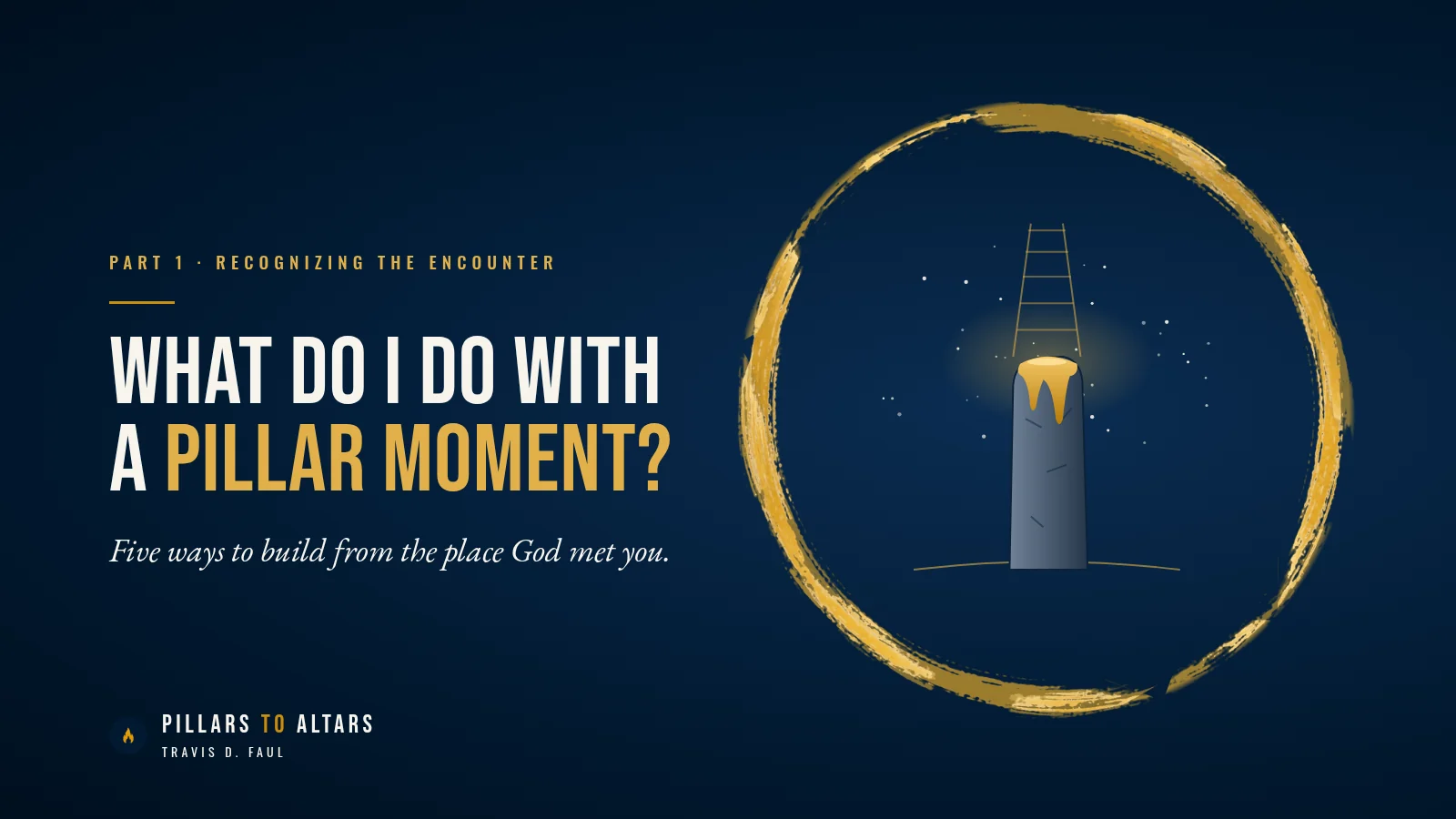
He stopped for the night, put a stone under his head, and dreamed of a stairway reaching to heaven with the Lord standing above it, speaking covenant promises over him:
“Behold, I am with you and will keep you wherever you go and will bring you back to this land. For I will not leave you until I have done what I have promised you.”
Genesis 28:15
When Jacob woke up, he said:
“Surely the LORD is in this place, and I did not know it.”
Genesis 28:16
Notice what he didn’t say. He didn’t say, “God finally showed up.” The encounter didn’t make God present. It made Jacob aware. A pillar moment is not the beginning of God’s presence. It is the beginning of our recognition.
That should give us hope. Jacob wasn’t a model of maturity. He was a complicated man in a complicated situation, and God revealed Himself anyway. God awakens us before we know how to walk.
Why a pillar isn’t the whole story
In the morning, Jacob took the stone he had slept on, set it up as a pillar, poured oil on it, and called the place Bethel, “house of God.”
Pillars matter, because we forget. We can have a genuine encounter with God and later wonder whether it was real. Remembering where He spoke, provided, and met us steadies us when we’re confused or afraid. Remembering isn’t nostalgia.
But a pillar can’t take the place of a life with God. If all we do is collect pillar moments, we can spend years moving from one encounter to the next without ever letting them form us. Jacob still had a long road ahead. He would wrestle with God and receive a new name. And years later, God called him back to the same place, this time to build an altar (Genesis 35:1).
A pillar says, “God met me here.” An altar says, “Because He met me here, I will not stay the same.”
Five ways to build from a pillar moment
So what do you actually do with the moment God met you? Here is the simple path I walk through in the book.
1. Remember it honestly. Don’t exaggerate it, and don’t minimize it. Just name what happened. Write it down if you can. Memory doesn’t replace relationship, but it helps us stay faithful when feelings fade.
2. Ask what it revealed about God. Did you see His mercy, His nearness, His holiness, His patience, or the Father’s heart? A pillar moment isn’t only about what we felt. It’s about what God made known. If we only chase the feeling, we may miss the revelation.
3. Ask what response it invites. Not every encounter asks for the same thing. Sometimes the response is repentance. Sometimes it’s trust, forgiveness, or courage. Sometimes it’s making something right, laying down an old pattern, or simply becoming available to God in a new way.
4. Test it and anchor it in Scripture. A real encounter with God won’t lead you away from His Word, His character, or the fruit of the Spirit. If a moment produces pride, fear, isolation, or disobedience, it needs to be tested carefully. If it draws you toward Jesus, leads to repentance, strengthens your faith, or makes you hungry for His Word, it may be something the Lord wants you to build from.
5. Take one faithful next step, no matter how small. You don’t need the whole road. You can pray, “Lord, what are You inviting me to do with what You showed me?” Then obey.
The bridge is “Here I am”
There’s a Hebrew word that sits right in the middle of all this: hineni. It’s usually translated “Here I am,” but it means more than a location. Abraham, Moses, Samuel, and Isaiah all answered God this way before they knew what obedience would cost. It’s the posture of someone who says, “I’m here for You. I’m listening, and I’m ready.”
In the book I put it like this: a pillar says, “God met me here.” Hineni says, “Here I am, Lord.” An altar says, “My life is Yours.”
That’s often how an altar life begins. Not with complete understanding or perfect maturity, but with remembrance, surrender, and one honest yes.
So here’s my invitation. Take a few minutes this week and write down the places where God has met you. Write what happened, what He showed you about Himself, what changed in you, and what response it seemed to invite. Not so you can live in the past, but so you can remember His faithfulness and give Him glory.
Then ask the question Jacob’s story leaves us with. The question isn’t only where God met you. It’s whether you’ll build from there.
Go deeper in Pillars to Altars, Chapter 1: Bethel and the Pillar Moment.